
The construction industry accounts for approximately 38% of global carbon emissions (UNEP 2022 Global Status Report), with embodied carbon in materials representing a growing share as operational energy efficiency improves. Within this context, the environmental profile of formwork systems — a seemingly niche category of construction equipment — carries disproportionate significance because formwork directly determines the consumption of three high-impact material streams: timber, concrete, and steel.
Aluminum formwork, evaluated through a full lifecycle lens, presents a fundamentally different environmental trajectory from traditional timber and steel formwork. Its sustainability advantages span material recyclability, construction waste elimination, concrete consumption reduction, and alignment with green building certification frameworks.
Aluminum Recyclability: A Closed-Loop Material
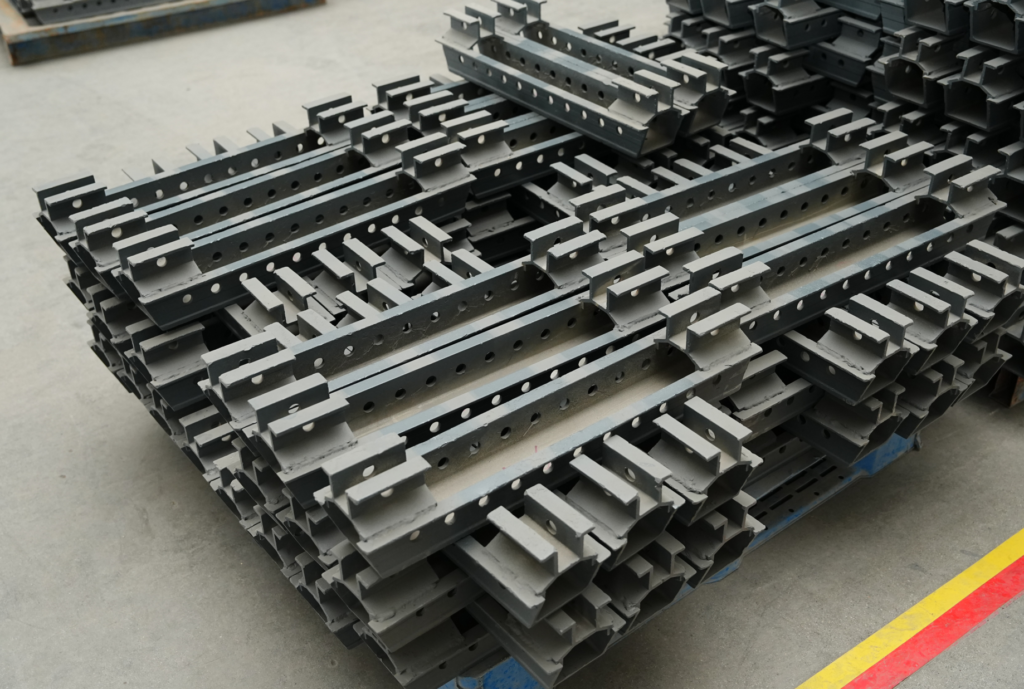
Aluminum is one of the few structural materials that can be recycled infinitely without degradation of its metallurgical properties. Unlike plastics, which downcycle with each reprocessing cycle, or timber, which has a finite cascade of reuse before ending as fuel or landfill, aluminum retains its full mechanical performance through any number of remelting cycles.
The energy economics of aluminum recycling are equally significant. Secondary aluminum production — remelting scrap — requires approximately 5% of the energy needed for primary aluminum production from bauxite ore (International Aluminium Institute, 2023). This means that at end-of-life, an aluminum formwork panel’s embodied energy can be carried forward into new aluminum products with a 95% energy saving relative to virgin material.
For formwork specifically, the practical implication is that panels retired after 200-300+ concrete pour cycles are not construction waste requiring disposal. They are high-grade aluminum scrap with an established collection, sorting, and remelting infrastructure in virtually every country with a construction sector. The manufacturer often accepts retired panels directly, either crediting their material value or re-processing them into new formwork extrusions.
In contrast, timber formwork at end-of-life — after 6-10 uses — is typically contaminated with concrete residue, release agents, and nails or screws. This contamination severely limits recycling options. Most used timber formwork is either landfilled (contributing to methane emissions as the wood decomposes anaerobically) or incinerated (releasing its embodied carbon directly to the atmosphere). Neither pathway recovers the material’s value.
Construction Waste Reduction
Construction and demolition waste represents approximately 30-40% of total solid waste generation in many developed economies (European Commission, 2022). Formwork-related waste — primarily timber offcuts, used plywood sheets, and packaging — is a significant contributor on concrete-frame construction sites.
Aluminum formwork eliminates several waste streams that are inherent to timber formwork construction:
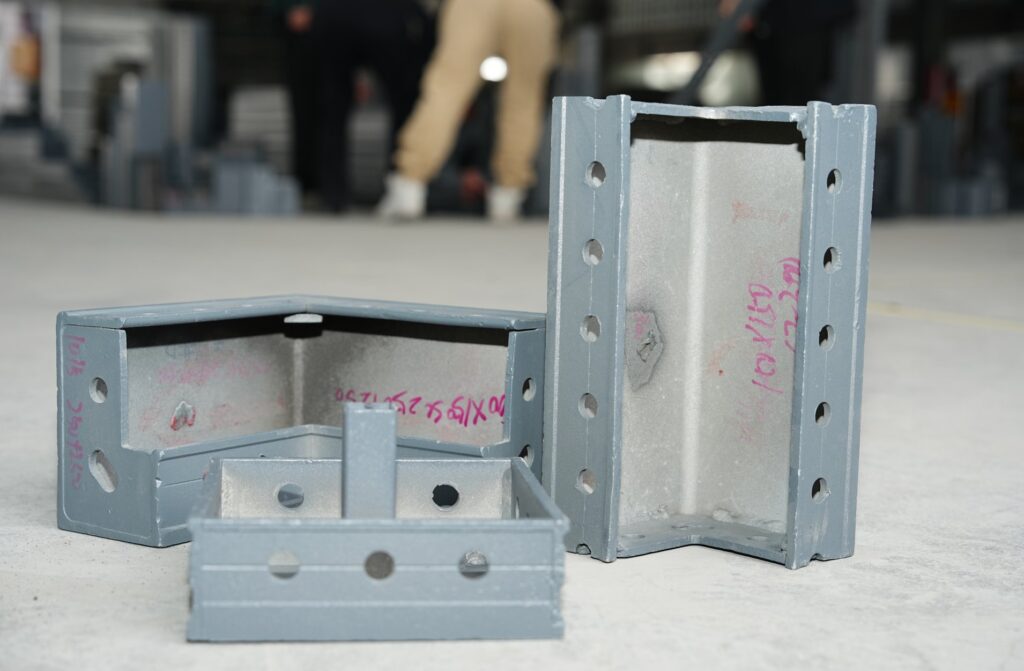
On-Site Cutting Waste: Timber formwork construction involves extensive on-site cutting of plywood sheets and timber studs to fit non-standard dimensions and penetrations. Offcut rates of 10-20% of total timber formwork material are typical. Aluminum formwork panels, being pre-fabricated to the project’s exact dimensions and assembled from standardized modular components, generate zero on-site cutting waste.
Disposable Formwork Material: A 30-story residential tower using timber formwork consumes approximately 400-600 plywood sheets (assuming 6 uses per sheet before replacement) over the project duration. At approximately 30 kg per sheet, this represents 12-18 tonnes of timber waste requiring disposal. The same project using aluminum formwork generates zero disposable formwork material — the panels remain in service.
Packaging Waste: Timber formwork materials arrive on site as individual sheets and lengths, each wrapped, strapped, or palletized. Aluminum formwork panels are pre-assembled into transportable sub-assemblies at the factory, with re-usable steel stillages or returnable packaging systems replacing single-use timber pallets and plastic wrapping.
Reduced Concrete Consumption
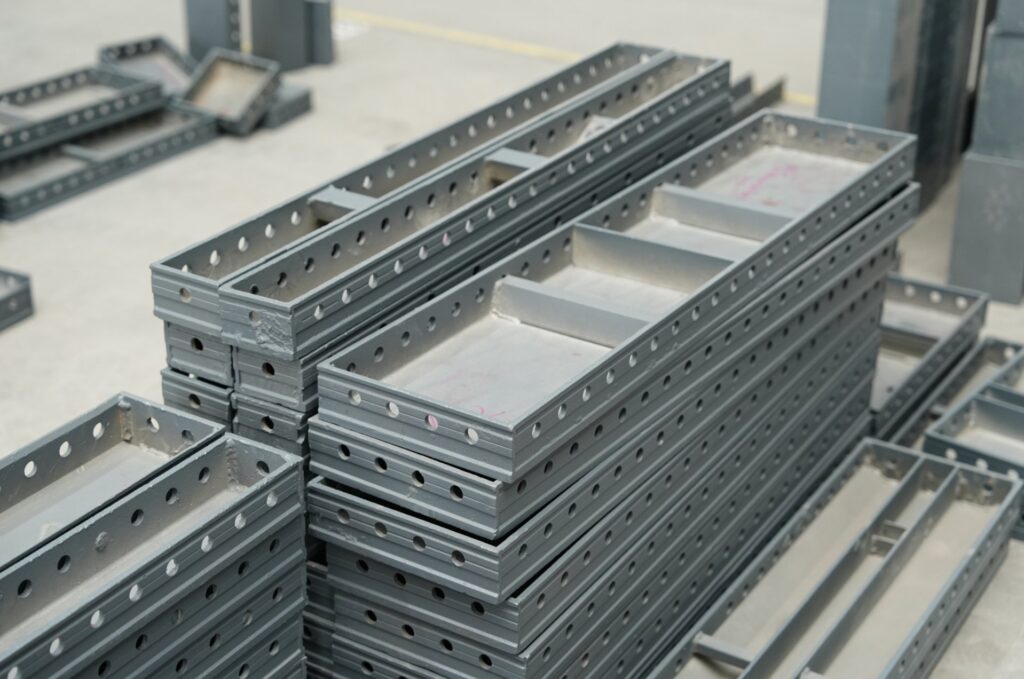
One of the less obvious but quantitatively significant environmental benefits of aluminum formwork is the reduction in concrete over-consumption. Concrete production accounts for approximately 7-8% of global CO₂ emissions, primarily from cement clinker production. Any reduction in concrete volume placed translates directly to reduced embodied carbon.
Traditional timber formwork, due to its dimensional variability and the practice of building in “construction tolerance” through slightly oversized forms, typically results in concrete over-pour of 3-5% relative to the design volume. On a 30-story tower with a design concrete volume of 8,000 m³, this represents 240-400 m³ of unnecessary concrete — carrying approximately 60-100 tonnes of CO₂ equivalent in embodied emissions.
Aluminum formwork’s dimensional accuracy and rigid panel connections enable concrete placement to much tighter tolerances. The precise form geometry, combined with the absence of formwork bulging (a common issue with timber under hydrostatic pressure), reduces over-pour to approximately 1-2% — saving roughly half the excess concrete volume.
Additionally, the direct-finish surface quality achievable with aluminum formwork eliminates the need for cement-based plastering on formed surfaces. On the same 30-story tower, eliminating 15-20 mm of plaster on both faces of all walls translates to approximately 150-200 tonnes of plaster material not manufactured, transported, mixed, and applied — each step carrying its own carbon footprint.
Green Building Certification Alignment
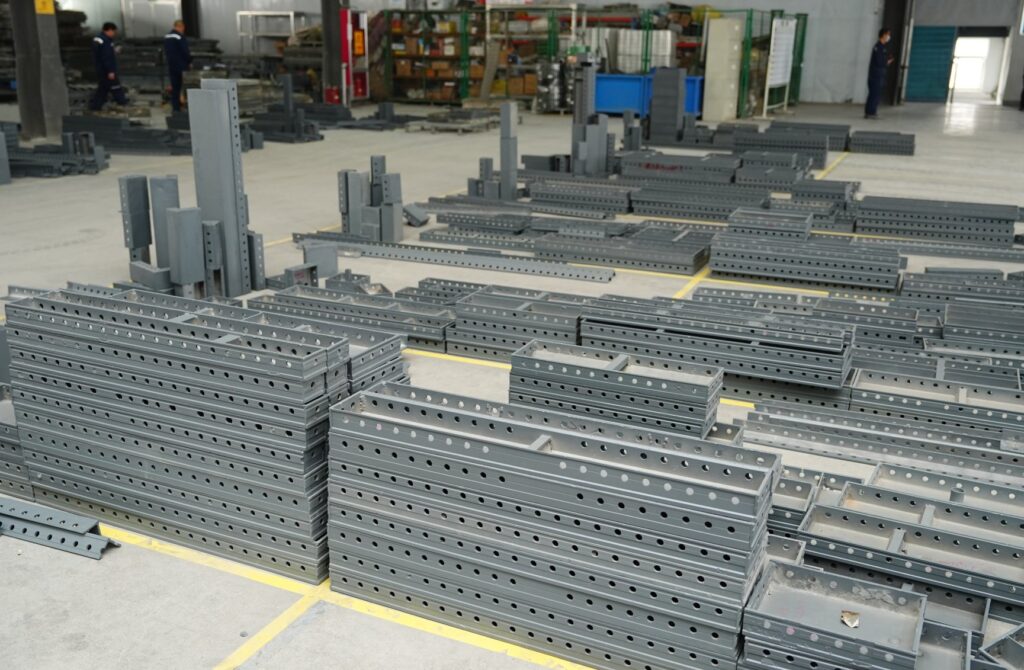
Aluminum formwork contributes directly to credits under major green building certification systems:
LEED v4.1 (Leadership in Energy and Environmental Design):
– MR Credit: Building Life-Cycle Impact Reduction — Aluminum formwork’s 200-300+ reuse cycles support the “whole-building lifecycle assessment” pathway by reducing construction-phase material consumption.
– MR Credit: Construction and Demolition Waste Management — The elimination of timber formwork waste directly reduces the project’s construction waste generation, supporting diversion rate targets of 50-75%.
– MR Credit: Sourcing of Raw Materials — Aluminum’s high recycled content (post-industrial and post-consumer scrap in extrusion billets) and established recycling infrastructure support responsible sourcing criteria.
BREEAM (Building Research Establishment Environmental Assessment Method):
– Wst 01: Construction Waste Management — Zero on-site formwork cutting waste and reduced packaging waste contribute to waste reduction benchmarks.
– Mat 01: Life Cycle Impacts — The extended service life and recyclability of aluminum formwork panels reduce the project’s embodied environmental impact in the “superstructure” element category.
Green Star (Australia):
– Credit 19: Construction and Demolition Waste — Aluminum formwork’s waste elimination supports the “no more than 7.5 kg of waste per m² of GFA” target for best-practice projects.
– Credit 21: Sustainable Materials — Aluminum’s recycled content and recyclability align with material stewardship criteria.
Lifecycle Carbon Comparison
A simplified lifecycle carbon comparison of formwork systems, based on a representative 25-story residential tower (600 m²/floor, 15,000 m² total GFA), illustrates the magnitude of difference:
| Impact Category | Aluminum Formwork | Timber/Plywood Formwork | Steel Formwork |
| Formwork material consumption (tonnes) | ~15-20 (one-time, multi-project asset) | ~40-60 (consumed across project) | ~50-70 (one-time, multi-project asset) |
| On-site formwork waste (tonnes) | ~0 | ~15-25 | ~1-2 (steel banding, connectors) |
| Concrete over-pour (% of design volume) | 1-2% | 3-5% | 1-2% |
| Plaster material eliminated (tonnes) | ~150-200 | Not eliminated | Not eliminated (similar finish to aluminum) |
| End-of-life pathway | 100% recycling | Landfill/incineration | 95%+ recycling |
| Recycled content in new panels | 60-80% (typical) | 0% | 30-50% (typical) |
The table illustrates that aluminum formwork’s environmental advantage is multi-dimensional — it is not a single attribute (such as recyclability alone) but the combination of material longevity, waste elimination, concrete reduction, and end-of-life recovery that collectively establishes a compelling sustainability case.
Summary
Aluminum formwork aligns with the construction industry’s trajectory toward circular economy principles in three fundamental ways: design for longevity (200-300+ reuse cycles instead of single-digit cycles), design for material recovery (infinite recyclability with 95% energy saving), and design for waste prevention (zero on-site cutting waste, reduced concrete over-pour, elimination of plastering). For project teams targeting green building certification or corporate embodied carbon reduction commitments, aluminum formwork represents one of the more impactful specification decisions available at the construction methodology level.
Keyword Matrix — Article 5
| Category | Keywords |
| Core Keywords | aluminum formwork sustainability, sustainable construction formwork, aluminum formwork environmental benefits, green building formwork, eco-friendly formwork |
| Long-Tail Keywords | aluminum formwork recyclability and sustainability, environmental impact of aluminum formwork, aluminum formwork green building certification, aluminum formwork carbon footprint reduction, construction waste reduction aluminum formwork |
| B2B Procurement Keywords | sustainable aluminum formwork supplier, green construction formwork manufacturer, LEED compliant formwork, circular economy construction formwork, environmentally friendly formwork system |
| Geo-Targeted Keywords | sustainable formwork UK, aluminum formwork green building Singapore, LEED formwork UAE, eco formwork Australia, green construction formwork Canada |