
The economic rationale for aluminum formwork adoption rests on a single parameter: reuse cycles. Unlike timber formwork, which is effectively a consumable material replaced multiple times across a project, aluminum formwork functions as a durable capital asset whose value is amortized across hundreds of concrete pours. Understanding the factors that determine reuse capacity — and the operational practices that maximize it — is essential for project planners and procurement decision-makers.
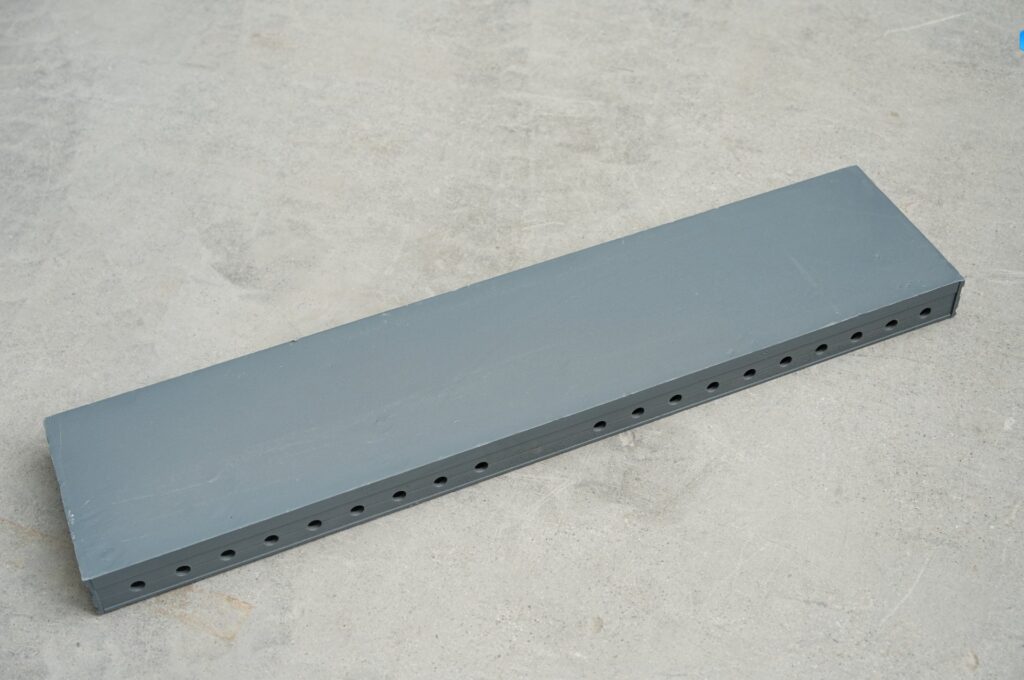
Reuse Cycle Benchmarks by Component
Aluminum formwork is not a monolithic product with a single service life. Different components within the system experience different levels of mechanical stress and wear, leading to varying reuse capacities.
| Component | Typical Reuse Cycles | Primary Wear Mechanism | Replacement Trigger |
| Wall panels (face plate) | 200-300+ | Surface abrasion, impact damage during stripping | Surface roughness exceeding acceptable finish standard |
| Slab/beam panels | 250-350+ | Lower wear — less direct impact during stripping | Face plate deformation or corrosion pitting |
| Connecting pins/wedges | 500+ | Mechanical fatigue, deformation | Loose fit — failure to maintain panel alignment |
| Waler beams | 300-500 | Bending fatigue, corrosion at bolt holes | Visible deformation or cracking |
| Props and shores | 500+ | Thread wear, tube denting | Thread binding or structural denting |
| Stripping corners | 200-300 | Repeated mechanical loading during stripping | Cracking at stress concentration points |
As the table indicates, the wall panel — the component most exposed to concrete abrasion and stripping impact — is typically the limiting component that determines the overall system life. However, panels rarely fail catastrophically; their degradation is gradual, manifesting as increasing surface roughness and minor edge damage that eventually exceeds project finish quality requirements rather than structural safety limits.
By comparison, film-faced plywood (the highest grade of timber formwork) achieves 6-10 reuse cycles before delamination, edge damage, and moisture-induced warping render it unusable. Steel formwork panels typically achieve 50-100 reuse cycles before rust pitting, mechanical deformation, or weld fatigue require replacement.
The order-of-magnitude difference between aluminum (200-300+) and timber (6-10) cycles is the fundamental driver of aluminum formwork’s lifecycle advantage. A single set of aluminum formwork panels can serve the equivalent of 20 to 50 complete timber formwork sets.
Operational Factors Affecting Service Life
Achieving the upper range of reuse cycles — 250-300 or more — is not automatic. It depends on a disciplined operational regime that addresses the primary degradation mechanisms.
Release Agent Application: The single most important maintenance practice. A properly formulated release agent creates a microscopic barrier film between the aluminum face plate and the concrete, preventing both adhesion (which damages the panel during stripping) and chemical attack from the highly alkaline concrete paste. Water-based release agents, applied as a thin uniform coat after each cleaning cycle, are the industry standard. Inadequate or uneven application is the leading cause of premature panel surface degradation — concrete residue builds up on the face plate, requiring increasingly aggressive cleaning that accelerates wear.
Stripping Technique: The stripping corner mechanism is designed to release panels cleanly by applying leverage at a specific engineered point. Improper stripping — prying at panel edges with crowbars, hammering on face plates, or dropping panels from height during removal — concentrates stress at points the panel was not designed to bear. On well-managed sites, stripping is performed by dedicated crews trained in the correct tool use and sequence for each panel type. On poorly managed sites, panels can lose 30-50% of their potential service life through stripping damage alone.
Cleaning Protocol: After each pour cycle, panels must be cleaned to remove any concrete residue, release agent buildup, or surface contaminants. The recommended method is a plastic scraper or soft wire brush followed by a water wash — never a steel wire brush or hammer, which gouges the aluminum surface. Panels should be inspected during cleaning for edge damage, face plate deformation, and connector socket wear.
Storage Conditions: Between projects or during extended pauses in construction, panels should be stored flat on level racks in a covered area protected from direct sunlight and rain. Stacking panels on uneven ground, storing them exposed to weather, or placing heavy objects on top of panel stacks can cause permanent warping or corrosion that reduces subsequent service life.
Concrete Mix Design: While largely beyond the formwork contractor’s control, the concrete mix design affects panel wear. Mixes with high cement content, low water-cement ratios, or aggressive chemical admixtures can increase the alkaline attack on the aluminum surface, marginally accelerating surface degradation. Most standard concrete mixes used in residential and commercial construction do not pose a problem; specialized high-performance concretes may require consultation with the formwork manufacturer.
Lifecycle Usage Across Project Scales
To illustrate the practical significance of reuse cycles, consider three representative project scales:
Scenario A — Single 25-Story Residential Tower: Approximately 25 identical floor pours. An aluminum formwork set would consume roughly 8-12% of its total service life, leaving a substantial residual value for subsequent projects or resale. A timber formwork approach would require three to four complete sets of plywood, generating 15-20 m³ of timber waste per set.
Scenario B — Multi-Phase Development (3 × 25-Story Towers): Approximately 75 identical floor pours. An aluminum formwork set would consume 25-37% of its service life. The same set can be transferred from Tower 1 to Tower 2 to Tower 3 with only minor refurbishment between phases. A timber approach would require 8-12 complete sets of plywood across the three towers.
Scenario C — Mega-Project (10+ Towers): A single aluminum formwork set may approach or reach its full service life across the project, with panels replaced incrementally as they reach their wear limit. The per-pour formwork consumption — measured in kilograms of formwork material consumed per cubic meter of concrete placed — is two orders of magnitude lower than the timber equivalent.
Refurbishment and Panel Replacement Strategy
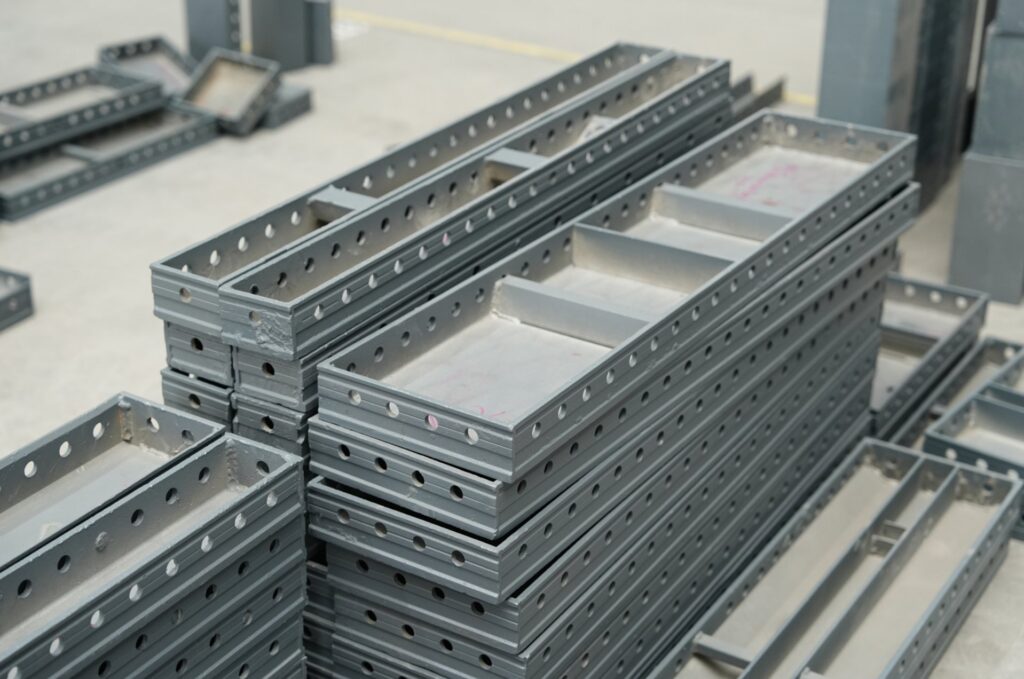
Aluminum formwork systems support a component-level replacement strategy rather than wholesale system retirement. As individual panels reach their wear limit — typically identified by surface roughness measurements during post-pour inspection — they are retired from the active set and replaced with new or refurbished panels. This approach allows the overall system to remain in service indefinitely, with only a fraction of panels replaced in any given maintenance cycle.
Worn panels are not waste. The aluminum alloy retains its metallurgical properties through any number of remelting cycles. Retired panels are typically returned to the manufacturer or a specialist recycling facility, where they are remelted and recast into new extrusion billets — closing the material loop with an energy expenditure of roughly 5% of the energy required for primary aluminum production.
Summary
The 200-300+ reuse cycle capacity of aluminum formwork represents a paradigm shift from formwork-as-consumable to formwork-as-capital-asset. When combined with disciplined maintenance practices and component-level refurbishment, the effective service life can extend across multiple projects spanning a decade or more of active use. This durability, coupled with aluminum’s infinite recyclability at end-of-life, establishes aluminum formwork as the lowest-waste, longest-life formwork technology available for repetitive concrete construction.
Keyword Matrix — Article 4
| Category | Keywords |
| Core Keywords | aluminum formwork reuse cycles, aluminum formwork service life, formwork durability, aluminum formwork lifespan, formwork reuse |
| Long-Tail Keywords | how many times can aluminum formwork be reused, aluminum formwork reuse cycle comparison, factors affecting aluminum formwork life, aluminum formwork maintenance guide, aluminum formwork vs timber reuse cycles |
| B2B Procurement Keywords | durable aluminum formwork, high reuse formwork system, aluminum formwork lifecycle, long-life formwork supplier, aluminum formwork refurbishment |
| Geo-Targeted Keywords | aluminum formwork lifecycle India, aluminum formwork durability UAE, formwork reuse cycles Australia, aluminum formwork maintenance Saudi Arabia, aluminum formwork lifespan Malaysia |