One-stop supplier for all kinds of formwork and construction materials.
Aluminum Formwork for High-Rise Buildings: Construction Efficiency & Technical Advantages

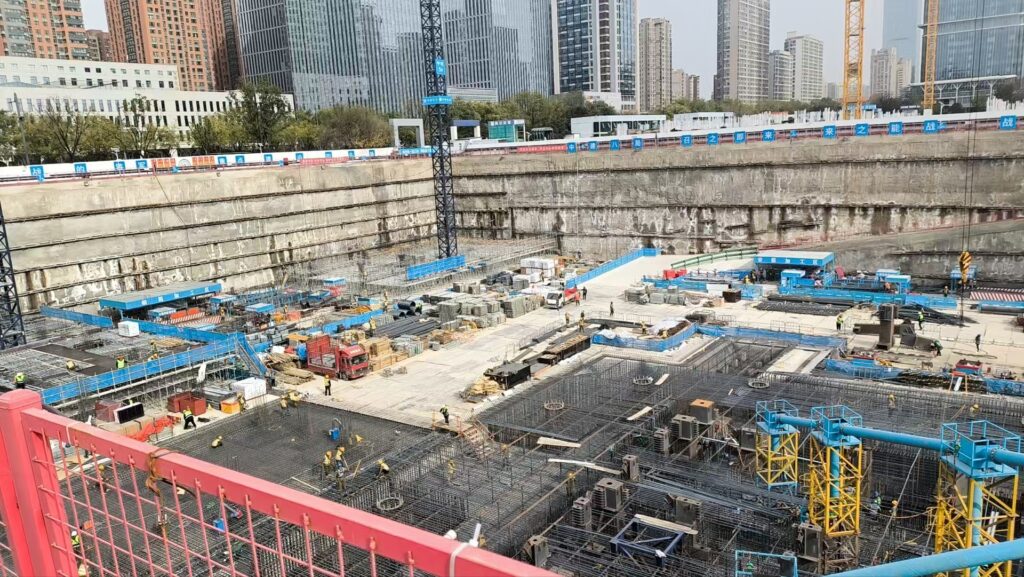
Advantages of Aluminum Formwork in High-Rise Building Construction
High-rise construction presents a unique set of engineering and logistical challenges that fundamentally differ from low-rise and horizontal construction. As building height increases, the relative importance of crane cycle time, vertical transportation capacity, construction cycle repetition, and dimensional consistency across floors becomes amplified. Aluminum formwork has emerged as the formwork technology most naturally aligned with these high-rise demands.
The High-Rise Construction Challenge
In a typical 30- to 50-story residential tower, the structural frame repeats an identical or near-identical floor plan on every level. This repetition creates both an opportunity and a constraint: the opportunity to industrialize the construction process through standardization, but also the constraint that any bottleneck — particularly crane availability and vertical transport — compounds across dozens of repeated cycles.
Traditional timber formwork addresses the repetition by deploying skilled carpentry crews to rebuild formwork on each floor. This approach has three inherent limitations: it consumes disproportionate crane time for material delivery, generates continuous on-site cutting waste, and produces variability in concrete geometry that accumulates across floors. Steel formwork solves the variability problem through rigid, reusable panels — but at a weight that makes every panel movement dependent on the tower crane, the single most congested resource on any high-rise project.
Aluminum formwork resolves this tension through a combination of lightweight modular design, rapid connection mechanisms, and early stripping capability — features that together reshape the high-rise construction workflow.
Lightweight Panels and Crane Independence
At approximately 20-25 kg/m², aluminum formwork panels fall well within the two-person manual handling limit recommended by occupational health and safety guidelines (typically 25 kg per person for repetitive lifting). This means that once panels are initially hoisted to the working floor as a batch, all subsequent positioning, alignment, connection, stripping, and transfer to the next pour location can be accomplished without crane involvement.
The operational significance of this cannot be overstated. A tower crane on a high-rise project typically services formwork, rebar, concrete placement (via skip), curtain wall panels, MEP riser materials, and miscellaneous deliveries. Crane time is measured in minutes, and any delay — wind shutdowns, competing priorities, mechanical issues — cascades immediately into the critical path.
By removing formwork panel movement from the crane schedule entirely, aluminum formwork frees approximately 30-40% of daily crane cycles for other trades. This reduction in crane dependency is particularly valuable on slender towers where only a single crane is installed.
Accelerated Floor-to-Floor Cycle Time
The floor-to-floor construction cycle is the fundamental unit of high-rise scheduling. Reducing this cycle by even one day per floor on a 40-story tower saves 40 calendar days from the structural frame program — a significant reduction that compresses general conditions duration and enables earlier commencement of follow-on trades.
Aluminum formwork systems routinely achieve floor cycle times of 4-5 days, compared to 7-10 days with timber formwork and 6-8 days with steel formwork. This represents a cycle time reduction of approximately 30-50% versus timber and 20-35% versus steel on comparable projects.
The cycle time compression derives from four factors acting in concert:
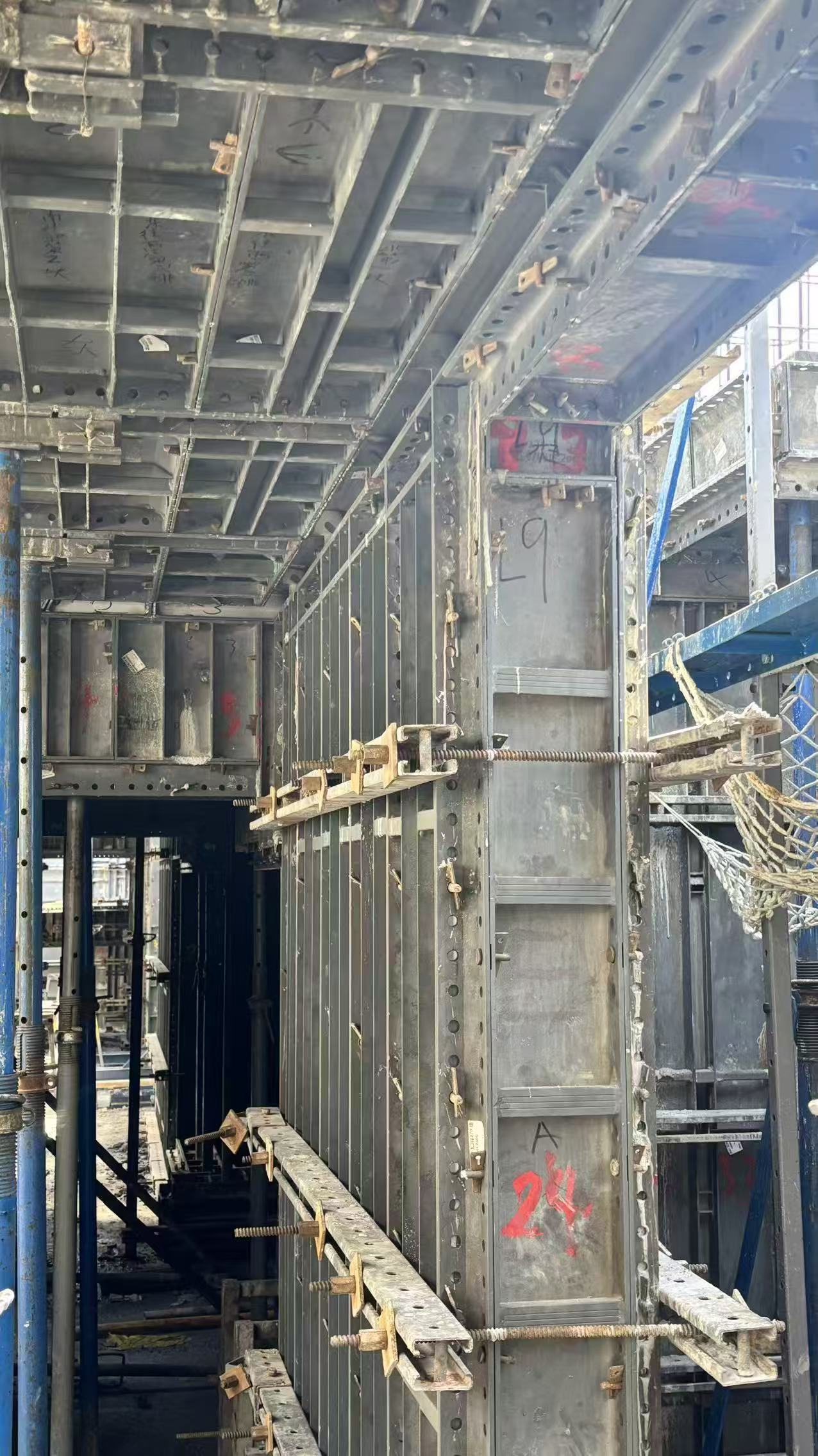
- Erection speed: Wedge-lock panel connections engage in seconds with a hammer strike. A full floor of wall and slab formwork can be erected by a crew of 12-16 workers in approximately 8-10 hours — a full day faster than the equivalent timber formwork erection.
- Alignment efficiency: Factory-manufactured panels with consistent dimensions eliminate the shimming and adjustment that timber formwork requires. Laser level verification confirms alignment rather than establishing it.
- Early stripping: The stripping corner mechanism allows wall formwork to be removed 12-18 hours after concrete placement, well before the concrete reaches its full 28-day design strength. This is possible because the formwork is non-load-bearing at this stage; the concrete self-supports.
- Horizontal-vertical workflow integration: On the day following a wall pour, workers strip wall forms in the morning and immediately begin erecting slab formwork. By afternoon, the next floor’s walls are being erected. This continuous workflow eliminates the idle days common in timber formwork cycles where curing and carpentry create scheduling gaps.
Dimensional Consistency Across Floors
In high-rise construction, small dimensional errors on lower floors propagate and amplify through the structure. A 3 mm deviation in wall position on level 5, if uncorrected, can become a 15-20 mm cumulative error by level 30 — exceeding allowable construction tolerances and requiring costly remedial work.
Aluminum formwork’s factory-manufactured panels maintain their geometry through hundreds of use cycles. Unlike timber, which absorbs moisture and warps, or steel, which can deform under impact during stripping, aluminum panels provide consistent dimensions from the first pour to the three-hundredth. A wall form erected on level 30 produces the same concrete geometry as the identical assembly on level 5, assuming correct placement.
This consistency has downstream effects beyond structural accuracy. Prefabricated components — precast staircases, bathroom pods, curtain wall brackets, MEP riser modules — depend on predictable concrete geometry for fit. Dimensional drift in the concrete frame can render prefabricated elements unusable without on-site modification, defeating the purpose of off-site manufacturing.
Labor Efficiency and Safety
High-rise construction sites in developed markets face chronic skilled labor shortages, particularly for experienced carpenters capable of timber formwork construction. Aluminum formwork systems shift the skill requirement from “carpentry expertise” to “assembly proficiency” — workers follow a pre-determined erection sequence using labeled panels, with the primary skill being the correct sequencing of assembly rather than the craft of measuring, cutting, and fitting.
A typical workforce deployment for an aluminum formwork floor cycle is 12-16 workers, compared to 18-25 for timber formwork. The reduction is concentrated in the elimination of on-site cutting and fitting labor.
From a safety perspective, the reduction in manual material handling — no carrying of plywood sheets up stairways, no on-site sawing, reduced crane lifts — contributes to a lower-risk working environment. The wedge-lock connection system also eliminates the trip hazards associated with scattered nails and timber offcuts on the working deck.
Case Profile: Typical 30-Story Residential Tower
In a representative 30-story residential tower with a floor plate of approximately 600 m² and a repetitive layout, the aggregate impact of aluminum formwork adoption can be quantified:
- Structural frame duration: reduced from approximately 35-40 weeks (timber) to 20-22 weeks (aluminum)
- Crane cycles saved: approximately 800-1,200 lifts eliminated over the full structure
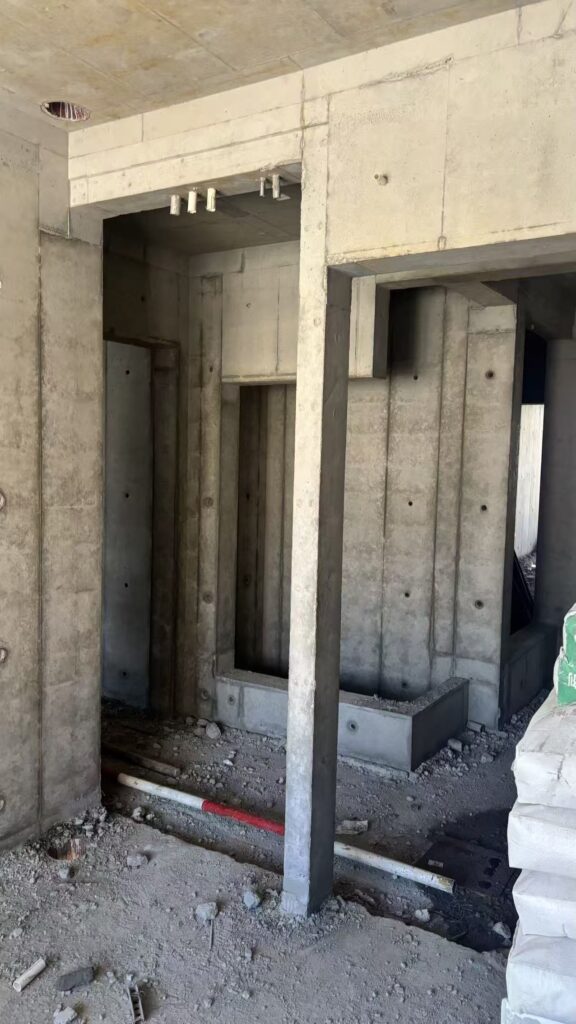
- Finishing time saved: direct-finish concrete surfaces on walls eliminate plastering on approximately 15,000-18,000 m² of wall area
- Waste eliminated: zero on-site timber formwork waste (approximately 15-20 m³ of timber waste per floor for traditional methods)
The combination of these factors makes aluminum formwork not merely an alternative to traditional methods, but increasingly the default specification for competitive high-rise construction in markets where the technology is well-established.
Keyword Matrix — Article 3
| Category | Keywords |
| Core Keywords | aluminum formwork high-rise building, high-rise construction formwork, aluminum formwork skyscraper, aluminum formwork residential tower |
| Long-Tail Keywords | advantages of aluminum formwork in high-rise construction, why aluminum formwork for tall buildings, aluminum formwork floor cycle time, aluminum formwork crane independent, high-rise concrete formwork system |
| B2B Procurement Keywords | aluminum formwork for high-rise projects, aluminum formwork contractor, high-rise building formwork supplier, aluminum formwork solution provider, construction formwork for towers |
| Geo-Targeted Keywords | aluminum formwork high-rise Dubai, aluminum formwork Singapore, aluminum formwork Hong Kong, aluminum formwork London, aluminum formwork Toronto |
AP Building Materials
Shaanxi Hangtou Anping New Materials Technology Co., Ltd. — a one-stop manufacturer of aluminium formwork, steel formwork, scaffolding and support systems for contractors in 30+ markets.
Products
Aluminum FormworkSteel FormworkPlastic FormworkRinglock ScaffoldingSteel SupportShear Wall ReinforcementFormwork AccessoriesLanguage
Contact
info@aluminumformpro.com
+86 29 8888 6666
Shaanxi, China
Privacy Policy Terms & Conditions